
Polyaspartic vs Epoxy Garage Floor Coatings: Which One Belongs on Your Slab
Two quotes, two chemistries. Compare polyaspartic and epoxy garage floor coatings on cure time, cold weather, UV stability and hot tire resistance, plus the hybrid system most good quotes actually describe.

If one quote says epoxy and the other says polyaspartic, the real question is not which chemistry is better. It is which one fits your cure window, your sun exposure, and the month the crew can get to you. Those three variables settle the polyaspartic vs epoxy garage floor question more often than any spec sheet. The crews at CreteWorx in Castle Rock install both.
The Short Answer
Polyaspartic wins when you need the garage back fast, when the slab sees real sun through an open door, or when the install happens in cold weather. Epoxy wins when the slab needs leveling and when the installer needs a long working window. Is polyaspartic better than epoxy? On cure speed, UV stability, temperature tolerance, and hot tire resistance, yes. On build thickness, leveling, and cost, no. Most good professional systems use both, which changes how you read your two quotes.
Two Chemistries, and Why the Difference Shows Up on Your Floor
Epoxy
Epoxy is a two-part thermoset: a resin and a hardener that react into a rigid, closely cross-linked film. Most decorative garage epoxies are aromatic, so the backbone breaks down under ultraviolet light and the floor ambers, then chalks, wherever it sees sustained sun. Epoxy also builds thick, so one coat levels minor slab imperfections, and it cures very hard, which also makes it brittle.
Polyaspartic
Polyaspartic is a type of aliphatic polyurea, developed in the 1990s to protect steel structures such as bridges before it moved into decorative concrete flooring. Aliphatic means UV stable, the biggest appearance difference between the two. If you are weighing a third option, epoxy against a polyurethane topcoat for a garage is a separate comparison we cover elsewhere.
It goes on thinner and stays more flexible, which matters on a slab that moves seasonally over expansive Front Range soils. It also cures fast, its headline feature and its biggest installation risk.
Polyaspartic vs Epoxy at a Glance
Typical ranges for professionally installed systems.
| Factor | Polyaspartic | Epoxy |
| Chemistry | Aliphatic polyurea | Two-part thermoset, usually aromatic |
| Tack free | Often 1 to 2 hours | Several hours to overnight |
| Cure to foot traffic | Same day | About 24 hours |
| Cure to vehicle traffic | Roughly 24 hours | Commonly 5 to 7 days |
| Time between coats | Often same day | Typically 12 to 24 hours |
| Working window | Very short, often minutes | Considerably longer |
| Application temperature | Very wide, including cold substrates | Generally 50 to 60 degrees Fahrenheit or warmer |
| UV stability | Stable, holds color | Ambers and chalks under UV |
| Hot tire resistance | More resistant | More prone to pickup |
| Film build per coat | Thinner | Thicker, better at leveling |
| Flexibility | More flexible, tolerates slab movement | Harder, more brittle |
| Odor and VOC | Typically low odor, low VOC | Solvent-based versions can be strong |
| Relative installed cost | Higher | Lower for a comparable system |
Polyaspartic generally carries a higher installed cost than a comparable epoxy system, but the two systems quoted are rarely comparable. Layer count, flake coverage, and prep method move the number more than the resin does, as our guide to garage floor coating cost in Castle Rock explains.
The One Day Garage Floor Coating vs Epoxy Timeline
A one day garage floor coating is possible because polyaspartic recoats in hours instead of overnight, not because a step gets skipped.
What a single-day install actually looks like
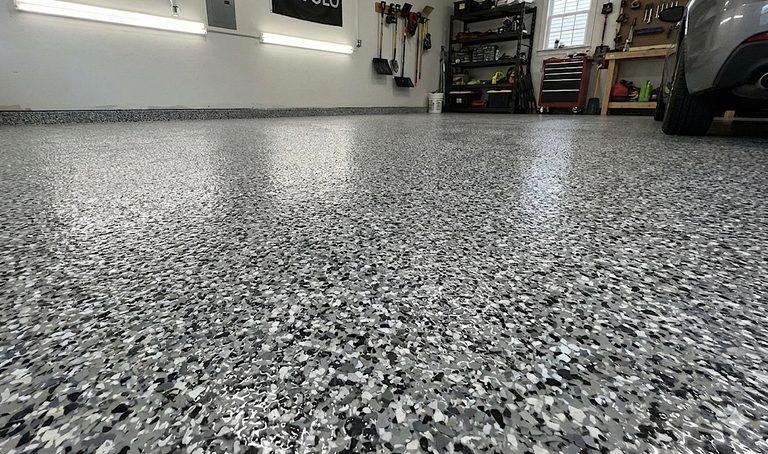
On a two-car garage with a sound slab, the day runs close to this. Early morning, the garage is emptied and the slab is mechanically profiled with a diamond grinder or shot blaster, then vacuumed. Cracks, spalls, and control joints get addressed. Late morning, the base coat goes down and flake is broadcast to refusal into the wet coat. Early afternoon, excess flake is scraped and vacuumed back off. Mid afternoon, the clear topcoat goes on. By evening the floor is usually tack free and ready for careful foot traffic, with vehicles held off roughly a day.
Why the short pot life makes this a crew-skill product
Polyaspartic has a very short working window, commonly measured in minutes once mixed. An experienced crew mixes small batches, stages the room before anything is opened, and keeps one person cutting in while another rolls. An inexperienced crew mixes too much and has to outrun the material.
What gets rushed shows up later: roller lap marks where a wet edge was lost, thin perimeter spots, flake broadcast unevenly because the base coat started to set, topcoat pushed over a section already going off. Epoxy forgives a slow installer. Polyaspartic does not.
One day describes the coating, not the preparation
A same-day finish still requires the same full mechanical prep as a multi-day epoxy build. If a quote promises a one day install but describes an acid etch instead of grinding or shot blasting, the day is being saved in the wrong place.
Cold Weather, Colorado, and the Install Calendar
An epoxy garage floor in cold weather is a real scheduling constraint in Colorado, and polyaspartic is much less constrained. Epoxy generally needs the substrate at roughly 50 to 60 degrees Fahrenheit or warmer, and at least 5 degrees Fahrenheit above the dew point to avoid amine blush. From November through March in an unheated Castle Rock garage, a slab on cold ground can stay under that threshold all day even when the air feels tolerable.
Under-cured epoxy is the failure nobody sees coming, because it looks finished. It stays soft, picks up tire marks early, and can develop a greasy amine blush that ruins intercoat adhesion. Polyaspartic applies across a much wider temperature range, which is why it owns the winter schedule here.
A good contractor measures slab temperature and dew point rather than air temperature, runs heat long enough for the slab to warm through, and reschedules when the numbers do not work.
UV and the Open Garage Door
The strip just inside the door is where they diverge fastest. At Front Range altitude UV exposure is high, and a south or west facing door left open puts sustained ultraviolet on the first several feet of slab. Aromatic epoxy there ambers and chalks, leaving a visibly warmer band across the entry.
Polyaspartic holds its color, which is why it is the standard topcoat even when the body of the system is something else. Our overview of decorative coating finishes and durability covers how flake and metallic systems age.
Where Epoxy Still Wins
Epoxy earns its place. It builds thicker per coat, filling minor pitting, trowel marks, and irregularity a thin coating would telegraph right back. Its longer working window lets a large garage be coated in one pass without losing a wet edge. It costs less for comparable thickness, and its hardness gives excellent abrasion and chemical resistance.
Epoxy is a poor fit for a sun-exposed floor, a winter install in an unheated space, an attached garage where solvent odor migrates into the house, and any schedule that cannot spare five to seven days before a vehicle returns.
The difference bites hardest on hot tire pickup: warm tires park on the coating, plasticizers in the rubber soften the film, and it releases from the slab and sticks to the tire, leaving crescent-shaped bare patches. Epoxy is more prone to it, especially when under-cured, applied thin, or laid over prep that never gave it a mechanical bond.
The Hybrid System Most Good Quotes Actually Describe
The majority of professional garage systems are hybrids, not pure one-or-the-other. The most common residential build is an epoxy body coat, a full flake broadcast to refusal, and a polyaspartic clear topcoat. That buys the epoxy's film build underneath and the polyaspartic's UV stability and wear resistance on top, where every tire and sunbeam lands.
Homeowners comparing two quotes are often comparing a hybrid to a single-product system without knowing it. A quote labeled "epoxy floor" might be epoxy top to bottom, or epoxy with a polyaspartic topcoat. A quote labeled "polyaspartic" might be polyaspartic throughout, or a topcoat over an epoxy body. Four different floors, two words. Our guide on choosing the right concrete coating for your garage helps match a system to the space.
How to Read Two Quotes That Both Say "Epoxy Floor"
Ask for the system layer by layer and the comparison resolves itself. Get these in writing:
- Prep method. Diamond grinding or shot blasting, not acid etching, plus how cracks and control joints are handled.
- Moisture testing. Whether slab moisture is checked, and the plan if it comes back high.
- Every layer, named. Base coat chemistry, flake coverage, topcoat chemistry, and how many topcoats.
- Total system thickness and coat count, so you compare build to build.
- Return to service for foot traffic and for vehicles, in actual days.
- Texture. Whether an anti-slip additive is included, which matters with snowmelt and de-icer drip.
If one quote answers all six and the other says "epoxy, two coats," that is not a price difference. Those are two different products, and our concrete coatings service page lists the finishes and systems we build.
Both systems also fail for the same reason far more often than either fails on chemistry: inadequate surface preparation and unaddressed moisture vapor moving up through the slab. A perfectly specified polyaspartic over a poorly profiled, damp slab will delaminate, and so will the finest epoxy.
Frequently Asked Questions
Is polyaspartic better than epoxy?
Polyaspartic is better on cure speed, UV stability, cold weather application, flexibility, and hot tire resistance. Epoxy is better on film build, leveling, working window, and cost. For most residential garages the strongest result is a hybrid using each where it performs best.
What are the polyaspartic garage floor pros and cons?
The pros are same-day foot traffic, roughly 24 hours to vehicle traffic, UV stability, a wide application temperature range, low odor, and flexibility over a moving slab. The cons are higher installed cost, a thinner film that hides less surface imperfection, and a working window measured in minutes.
Can polyaspartic be installed in winter?
Yes, and that is one of its clearest advantages in Colorado. It applies across a much wider substrate temperature range than epoxy, including cold conditions where epoxy would not cure properly. A good installer still measures slab temperature and dew point.
Does polyaspartic yellow?
Aliphatic polyaspartic is UV stable and holds its color, so it does not amber the way aromatic epoxy does. That is why it is used as the topcoat in so many systems, including over an epoxy base.
How long does a polyaspartic garage floor last?
With proper preparation and sealing, high-quality coatings can last 10 to 15 years or longer. What moves that number most is not the resin, it is the preparation underneath and whether slab moisture was addressed first.
Can I install polyaspartic myself?
It is a poor DIY product, mainly because of the pot life. Once mixed you have minutes, not hours, and a lost wet edge cannot be fixed without recoating. The prep also needs a diamond grinder or shot blaster, the step most DIY kits skip.
Get a Straight Comparison for Your Garage
The right answer depends on your slab, your sun exposure, and your timeline. We will walk the garage, check the concrete and the moisture situation, and quote the system layer by layer. Reach out to CreteWorx for a free on-site estimate in Castle Rock, Douglas County, and the south Denver metro.
Written by CreteWorx · Castle Rock, CO


