
Garage Floor Coating Cost in Castle Rock: What You'll Actually Pay
Garage floor coatings run about $4 to $12 per square foot installed, putting a 2-car garage near $1,600 to $4,800. Here is how that number is built, what a low bid leaves out, and every variable that moves a Castle Rock quote.

Professionally installed garage floor coatings generally run $4 to $12 per square foot, which puts a standard 2-car garage of roughly 400 square feet in the $1,600 to $4,800 range. Those are typical ranges, and actual prices may change depending on the scope of your project, the cost of materials and other factors. What follows is how that number gets built, and why two bids on the same slab can differ by thousands. CreteWorx, a Castle Rock concrete contractor with more than 20 years in the trade, prices every floor after standing on it.
Read this before you use any number on this page
The prices below are general ranges, not a quote. Actual prices may change depending on the scope of your project, the cost of materials, labor and site conditions, so use them as a starting point and get a quote for your own floor.
Three things make that distinction matter:
- These numbers move. Resin and material pricing shifts with supply, fuel and manufacturer changes, and labor rates move with the season and demand. A range that is accurate this quarter can be off next year. Nothing on this page is guaranteed to be current when you read it.
- Scope decides the number, not the category. Two garages of identical size can differ by thousands depending on slab condition, what has to come off first, how many coats go down, and how much hand work the room requires. "2-car garage" is not a price. A scope is.
- Only a site visit produces a real figure. No contractor can price your garage from a phone call or a photo, and any who does is guessing at your expense.
For current CreteWorx pricing on your specific garage, ask CreteWorx directly. The estimate is free, it is based on standing on your slab, and it is the only number on this subject that is actually yours.
Cost per square foot is the number that travels
Cost per square foot is the only figure that lets you compare two quotes fairly, because it strips out the variable that skews everything else: the size of your slab. A $3,400 bid sounds high until you learn it covers 576 square feet, which is about $5.90 per square foot, mid-band.
Converting a quote is simple: measure the floor wall to wall, multiply length by width, then divide the bottom line by that square footage. Do not use the nominal size from your house plans. A "24 by 24" garage often measures closer to 23 by 23 feet inside the framing, and that difference is real money.
Ask each contractor what square footage their bid was built on. If one measured and one estimated from the driveway, you are not comparing the same floor. Per square foot still hides scope, so it belongs next to an itemized scope sheet, not instead of one.
Where the money goes
Materials typically account for $1 to $6 per square foot and labor for $3 to $6. A thin single-coat roll-on over minimal prep sits at the bottom of both bands. A ground, patched, multi-coat flake system with a premium topcoat pushes both up at once, which is why totals climb fast.
Garage floor coating cost by garage size
Match the square footage closest to your measurement rather than the label, since "2-car" covers a wide spread of real floor sizes.
| Garage | Typical dimensions | Approximate square footage | Typical installed cost range |
| 1-car | 12 by 24 feet | 288 sq ft | $1,200 to $3,500 |
| 2-car | 20 by 20 feet | 400 sq ft | $1,600 to $4,800 |
| 2-car oversized | 24 by 24 feet | 576 sq ft | $2,300 to $6,900 |
| 3-car | 24 by 36 feet | 864 sq ft | $3,500 to $10,400 |
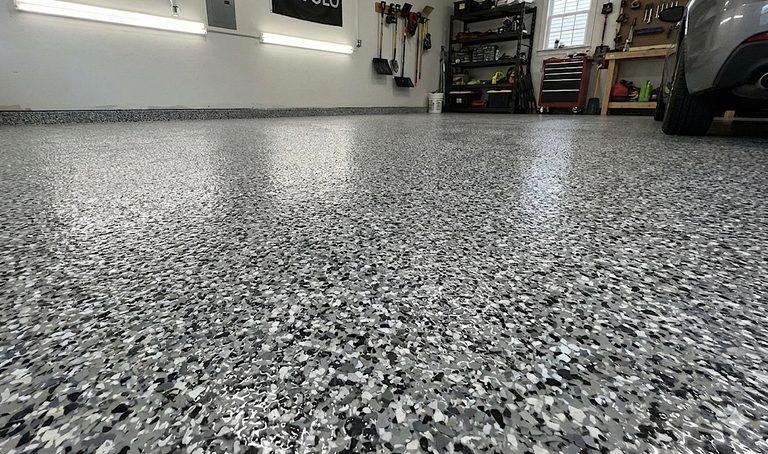
Most Front Range residential jobs land in the middle of these bands. The low end means a single-coat roll-on over minimal preparation. The high end means full mechanical grinding, extensive crack and spall repair, a full flake broadcast and a premium topcoat. Both are real products. They are not the same product.
System tiers and what the price difference buys
The resin system sets the floor and ceiling of your quote before anything else is measured. Typical per square foot ranges, installed:
- Epoxy: $4 to $10 per square foot
- Polyurea: $5 to $10 per square foot
- Polyaspartic: $5 to $12 per square foot
The premium tiers buy three things: faster cure, better UV stability so the finish resists ambering where sun hits the slab inside the door, and greater abrasion and impact resistance under hot tires. Which one suits your garage is a longer conversation than a pricing page should hold, so read the breakdown of how to choose the right concrete coating for your garage and come back with a system in mind.
Slab condition is the biggest swing factor in any quote
Slab condition moves a garage coating quote more than any other variable, and it is the one homeowners never budget for. A coating is a surface treatment. It cannot bridge a structural problem, and a good contractor prices the repair rather than coating over it.
Concrete repair or resurfacing before coating typically runs $3 to $7 per square foot on the affected area. On a badly pitted slab, that line alone can rival the coating. What drives it up:
- Cracks. Hairline shrinkage cracks get chased and filled. Working cracks that have moved with the seasons need routing and sometimes a joint treatment so the coating does not telegraph and split.
- Spalling and pitting. Surface loss from de-icer damage has to be patched flat first, or the texture shows through every coat.
- Oil saturation. Years of drips soak into the capillary pores. Degreasing may not be enough, and contaminated concrete sometimes has to be ground deeper or cut out.
- Moisture vapor. Slabs without an intact vapor barrier can push moisture up through the concrete and debond a coating from underneath. Testing is cheap. Re-coating a failed floor is not.
Walking your slab alongside the guide on how to spot concrete damage before it gets worse will tell you roughly what a contractor is going to see.
Removing a failed coating is the most expensive surprise on most quotes
Stripping an existing coating is routinely the largest unexpected line item on a garage floor bid. A peeling kit finish has to come off completely, which means grinding or shot blasting the whole floor with diamond tooling, containing the dust and hauling the debris. That is slow, and it is labor.
Homeowners are often surprised that a previously coated floor costs more than bare concrete, since it looks halfway done. Bare, sound concrete is the cheapest starting point there is. If a contractor quotes your coated floor without asking what is on it, that number is a guess.
Prep shows up on the quote as its own line
Surface preparation is a priced line item, and the method changes the total meaningfully. Basic cleaning and pressure washing lands around $0.35 to $0.77 per square foot. Mechanical profiling with a diamond grinder or shot blaster costs considerably more, and it is the difference between a coating that is bonded and one sitting on top of the slab.
The methodology behind profiling, testing and moisture mitigation is a subject of its own and gets covered separately. For pricing, find the prep line on the quote, see what method it names, and ask why that method was chosen for your slab.
Everything else that moves the number
With the system and slab condition set, these variables shift a quote by hundreds of dollars.
- Usable square footage versus footprint. Do not subtract for shelving. Do expect obstructions to raise labor. Built-in cabinets, water heater platforms and permanent workbenches all require hand cutting in around the perimeter, slow detail work a machine cannot do.
- Flake coverage. A light broadcast that lets base color show through uses a fraction of the material of a full broadcast to refusal, where flake is thrown until the floor stops taking it. Full broadcast also needs scraping and a heavier topcoat to bury the flake edges.
- Number of coats and mil build. Primer, base, broadcast and topcoat is a different product from one pigmented coat. Ask for total dry film thickness, not the number of buckets.
- Cove base. Turning the coating up the wall for a sealed, sweepable transition adds material and hand labor.
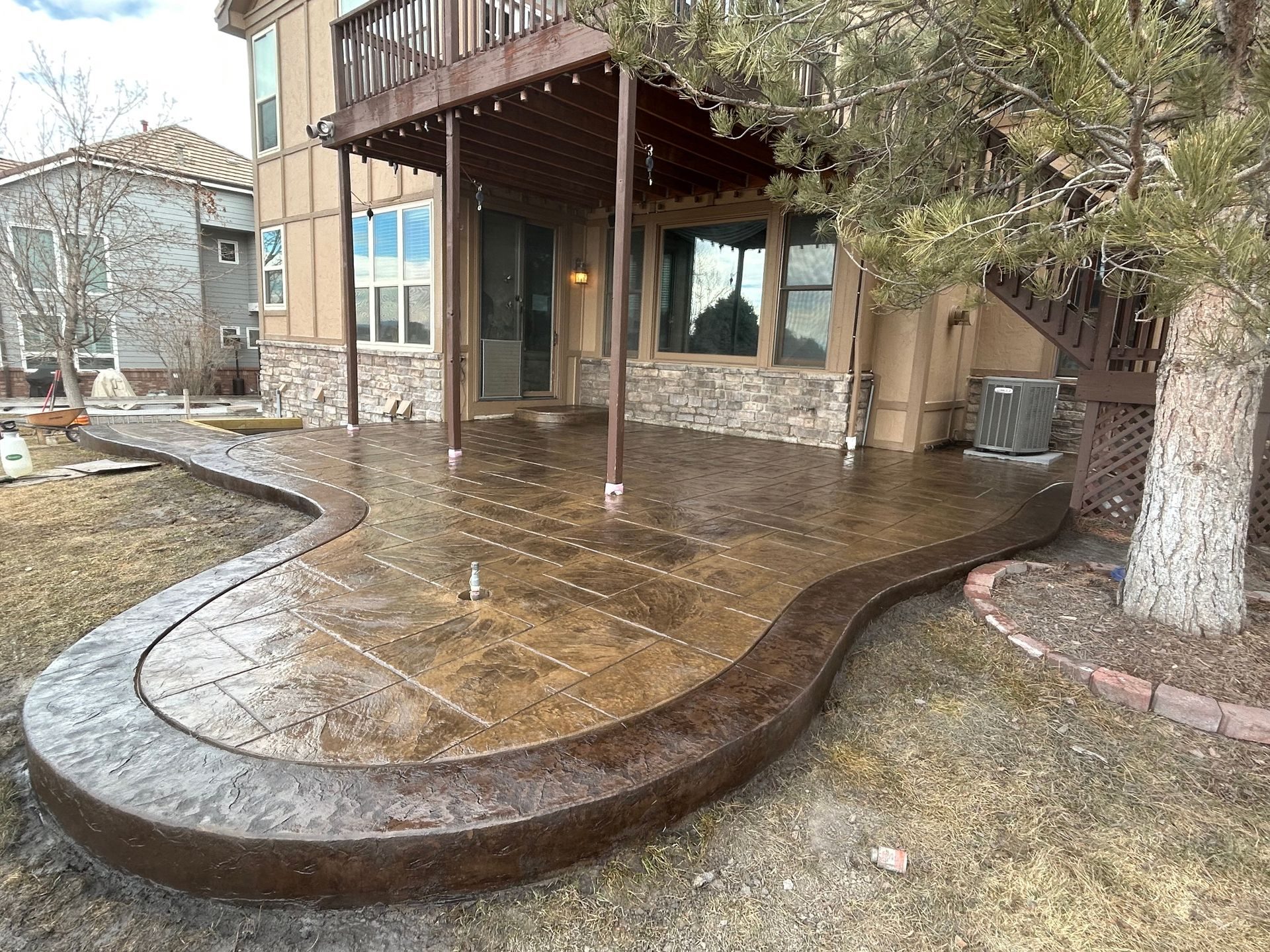
- Decorative finishes. Metallic systems and custom blends cost more in material and installer skill, because they are troweled and manipulated rather than rolled. The range of custom concrete coatings for garages and patios in Castle Rock shows what the finish levels look like.
- Stairs and thresholds. The step down from the house and any interior treads are priced separately. Small in area, heavy in labor.
- Floor drains. Drains require detailing, masking and a clean termination, and a sloped slab takes longer.
- Winter scheduling. Resin systems have minimum application and slab temperatures. In a Castle Rock January that can mean temporary heat, longer cure windows, or a hard no until conditions improve.
- Access. A detached garage at the back of a lot, or a floor that cannot be fully emptied, adds time.
What a low bid usually leaves out
A low bid is not automatically dishonest. It is usually a different scope, and the gap sits in the parts you cannot see once the job is done. The omissions to look for:
- Acid etching instead of mechanical grinding. Etching is faster and cheaper and produces a far less reliable profile, particularly on a hard-troweled slab.
- No moisture testing. Skipping it saves a little money and transfers all of the risk to you.
- A single-coat system. One coat over bare concrete looks fine for a season.
- Thin mil build. Two quotes can both say "epoxy" and differ by a factor of three in applied thickness.
- No crack or spall repair. If the quote does not mention the cracks you can see from the doorway, they are not in the price.
- No written scope. A one-line bid with a dollar figure gives you nothing to hold anyone to.
If a bid is far below the others, the useful question is not "why are you cheap" but "what is in the other quotes that is not in yours." The concrete coatings service page shows what a complete scope includes.
How to compare quotes without guessing
Compare scope sheets, not bottom lines. A quote worth taking seriously itemizes the prep method, the repairs included, the system and number of coats, the finish spec, the coverage area in square feet, and what is excluded. Questions that separate bids quickly:
- What square footage is this priced on, and did you measure it?
- How are you profiling the slab, and why that method here?
- Are you testing for moisture before you start?
- What happens to the price if you find something under the old coating?
- How many coats, and what total thickness?
- Who is actually on my floor, and how long will the garage be out of service?
Vague answers are more predictive than price. The checklist in what to expect when hiring a concrete contractor applies directly to coating bids.
Cost per year matters more than cost per square foot
With proper preparation and sealing, high-quality coatings can last 10 to 15 years or longer. Run that arithmetic and the cheap bid stops looking cheap. As an illustration only, a $3,200 system that holds for 12 years works out to roughly $267 a year, while a $1,600 system that delaminates in three works out to about $533 a year, before the cost of grinding it off. Neither figure is a quote, and no one can promise you a service life in advance. The point is that the comparison you should be running is cost against expected lifespan, not one bottom-line number against another.
Coating failure is rarely gradual. It peels in sheets when a tire turns on it, or bubbles along one wall where moisture is coming through. At that point you are paying for removal plus a new floor.
Is a coated garage floor worth it in Colorado?
In Colorado the case is stronger than in most of the country, because of what comes into the garage on your tires. Front Range roads are treated heavily with road salt and magnesium chloride brine all winter, and your vehicle carries that solution straight onto the slab.
An uncoated garage slab is porous. It absorbs de-icer brine along with the snowmelt running off the wheel wells, and when that saturated concrete goes through a freeze-thaw cycle the water expands inside the pore structure and pushes the surface apart. That is the mechanism behind the scaling you see in the parking-spot footprints of older Castle Rock garages. Magnesium chloride is especially aggressive because it tends to hold moisture in the slab rather than letting it dry.
A properly bonded coating seals that surface so the brine sits on top and gets mopped out instead of soaking in. It is the same principle behind protecting concrete driveways from freeze-thaw damage, applied to the slab that sees the concentrated version of the problem.
Frequently Asked Questions
How much does a 2-car garage floor coating cost?
Typical ranges put a standard 2-car garage of about 400 square feet at $1,600 to $4,800 installed, and an oversized 2-car near 576 square feet at $2,300 to $6,900. Where you land in that band depends mostly on slab condition and system choice, not on negotiation.
What is a normal garage floor coating cost per square foot?
Roughly $4 to $12 per square foot installed, depending on the resin system and the prep and repair required. Materials generally account for $1 to $6 of that and labor for $3 to $6. If a quote comes in well under $4, assume the difference is in prep, coats or film thickness.
How much does an epoxy garage floor cost in Castle Rock, CO?
Epoxy typically runs $4 to $10 per square foot installed, and Front Range residential jobs generally sit mid-band. It is usually the least expensive professional system, which is why it is the one most often quoted with minimal preparation. Compare the prep line, not the resin name.
Is polyaspartic worth the extra cost over epoxy?
It depends on sun exposure and how hard the floor gets used. Polyaspartic typically runs $5 to $12 per square foot against epoxy at $4 to $10, and the premium buys faster cure, better UV stability and higher abrasion resistance. Polyurea sits between them at $5 to $10, often as a base coat under a polyaspartic topcoat.
Can I coat a garage floor myself, and how much does a DIY kit cost?
Yes, and DIY kits typically run $2 to $4 per square foot in materials, putting a 400 square foot garage near $800 to $1,600 before tool rental. The savings are real, but failures trace back to prep: rented grinders are often underpowered for a hard-troweled slab, and most kits are thin single-coat products.
Are these garage floor coating prices current and accurate?
They are general ranges, and prices may change depending on the scope of your project, the cost of materials, labor and the season. Your own number depends on what your slab needs. Use these ranges to judge whether a bid is in a reasonable neighborhood, then contact CreteWorx for up to date pricing on your actual garage.
How long does a garage floor coating job take?
Most garage coating projects are completed in 1 to 2 days depending on the size and the chosen finish. Fast-cure systems can allow foot traffic the same day, with vehicle traffic waiting longer. Extensive repair or coating removal adds time before coating starts, so ask for a timeline that separates prep days from coating days.
Get a real number for your own floor
Prices on this page may change depending on the scope of your project and the cost of materials, so treat them as a guide rather than a quote. No honest contractor can price your garage from a phone call, because the slab decides the number: what is on it, what is under it, what has to come off first, and how much of the work has to be done by hand. CreteWorx prices every floor after seeing it in person, and a free on-site estimate is the only way to get a current, accurate number for your garage. If you are in Castle Rock, Douglas County or the south Denver metro, request a free on-site estimate from CreteWorx, bring the quotes you already have, and ask for pricing as it stands today rather than as it stood when this was written.
Written by CreteWorx · Castle Rock, CO


