
Slip-Resistant Garage Floor Coatings: How to Build Traction Into the Floor
Winter garage floors get slippery from de-icer film, not just water. Compare traction additives, see how grit is applied, and learn where texture actually belongs on the floor without making it impossible to clean.

The floor you almost went down on last week was probably not slippery on its own. It was wet, and it carried a film of road de-icer off your tires. Traction can be built into a garage coating, and it can be tuned so the parts you walk on grip harder than the parts you park on. CreteWorx installs textured, anti-slip finishes across Castle Rock and Douglas County.
The Short Answer
A slip resistant garage floor coating is a standard option, not a custom request. Grip comes from an additive broadcast into a wet coat or suspended in the final topcoat: aluminum oxide, silica sand, micronized polymer beads, or a full flake broadcast that textures itself. Aggressiveness is set by particle size and broadcast density. What it costs you is cleanability, since every bit of texture is somewhere for de-icer residue to sit. The usual answer is moderate texture everywhere, heavier in the walking zones.
Why a Garage Floor Gets Slippery in Winter
A coated garage floor is almost never slippery when it is dry and clean. The hazard follows a sequence: a vehicle pulls in loaded with snow and road spray, that load melts off the tires and wheel wells, and a thin sheet of water spreads across a hard, smooth surface.
The residue is the real problem, not the water
Colorado roads are treated heavily with liquid de-icers, magnesium chloride chief among them, and that brine comes home on your tires. When the water evaporates, the salts and the inhibitors and surfactants blended into those products stay behind as a thin, slick, faintly oily film you can feel with a hand.
That film is frequently what puts people on the ground, and it is why sweeping does nothing. A floor fine in October feels treacherous in January with the coating unchanged, carrying four storms worth of residue nobody washed off.
Cold slab, melt and refreeze
A slab in a December cold snap stays cold long after the air warms. Meltwater stays liquid in the warm tire path and refreezes along the colder perimeter or just inside the overhead door, putting the worst few square feet where everyone carrying groceries has to step.
Exterior concrete is a separate problem with different answers, so if the approach to your house is also slick, read our guide to slip resistant concrete outside the garage instead. Everything below is the floor inside the door.
Non Slip Garage Floor Coating Options, Compared Honestly
No additive is universally best; each trades grip against comfort, appearance, and cleanability.
| Additive | Aggressiveness | Cleanability | Comfort | Appearance | Best use |
| Aluminum oxide | Very high, angular grit | Poor, holds dirt, eats mops | Harsh on feet and knees | Matte and gritty | Where grip beats all else |
| Silica sand | Moderate to high, by grain size | Fair | Sandpaper feel when coarse | Uniform, dulls sheen | Economical floor-wide traction |
| Micronized polymer or polyethylene beads | Low to moderate, subtle | Good, closest to smooth | Comfortable, no bite | Minimal, softens gloss | Grip without sandpaper |
| Rubber or recycled rubber granules | Moderate, softer texture | Fair | Cushioned | Changes color and feel | Uncommon, work areas |
| Full decorative flake broadcast | Low to moderate, topcoat dependent | Good to fair | Comfortable | It is the finish itself | Floors already set on flake |
The flake detail almost nobody explains
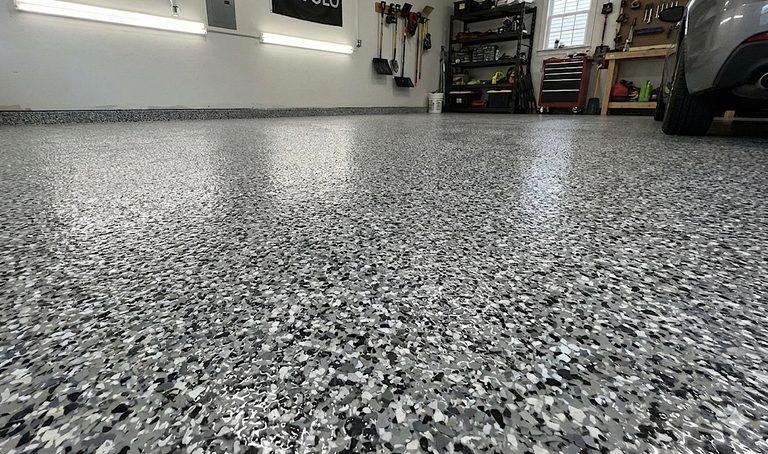
Flake broadcast to refusal, meaning thrown until the coat absorbs no more, develops texture from the raised chip edges before any additive is added. Whether it survives depends on what goes over it. One thin topcoat leaves real tooth. A heavy one flows out, buries the edges, and finishes glassy, which is why two flake floors on one street feel different underfoot.
How a Garage Floor Traction Additive Is Applied
- Broadcast into the wet coat, then locked in. Grit thrown into the wet coating and sealed with a topcoat is anchored, so the texture wears well. The failure mode is a heavy topcoat that floods the grit and flattens the texture you paid for.
- Suspended in the final topcoat. Mixed into the last coat and rolled, this gives a very even texture, but it must be kept agitated because the particles settle. Mix once, roll for forty minutes, and there is grip at the start of the run and almost none at the end.
Particle size and density are dials, and a good contractor puts down a sample and lets you walk it wet. The short working window on a polyaspartic topcoat compared with epoxy also leaves less time to broadcast evenly.
Traction Against Cleanability
These two pull against each other and no additive escapes it. Every peak added to the profile creates a valley beside it, and valleys collect grit and the de-icer film that caused the problem. More aggressive is not automatically safer: a floor that fights a mop gets cleaned less often, and cleaning frequency drives winter traction more than people think.
Texture also does nothing for adhesion, and a grippy floor that delaminates in eighteen months is still a failed floor, which is why our guide to garage floor coating preparation belongs alongside this one.
Zone the Floor Instead of Texturing It All Equally
Traction matters in three places: the paths beside and behind the vehicles, the route to the house door, and the strip inside the overhead door where snow drops off the car. Under a parked vehicle matters least. A contractor can vary texture by zone, moderate across the floor and heavier in those three areas, and most homeowners never ask. If you are planning a custom coating layout for your garage, zoning costs nothing to specify up front and is awkward to add later.
Gloss Versus Satin Is an Underrated Lever
Sheen affects both real and perceived slipperiness. High gloss shows every footprint and water spot, reflects glare, and reads slick before anyone steps on it. Satin or matte hides residue and looks less like ice. Sheen will not make a smooth floor safe when wet, but it lets you get there with a less aggressive additive. Among concrete coating systems, dropping from gloss to satin is the cheapest change on the list.
What ANSI A326.3 and DCOF Actually Tell You
ANSI A326.3 is the American National Standard test method for measuring the dynamic coefficient of friction, or DCOF, of hard surface flooring materials. It sets a minimum wet DCOF of 0.42 for level interior surfaces expected to be walked on wet.
Two things to keep straight. It was written for hard surface flooring materials such as ceramic tile, and a residential garage coating is not required to be tested to it. And no honest contractor can claim a finished floor meets it, since the result depends on the topcoat, the additive, the density, and the floor's condition when measured. Treat 0.42 as a reference point, not a certification.
Ask instead whether the manufacturer publishes slip resistance data for the exact topcoat and additive proposed. When they do not, ask for a sample area and test it with a bucket of water and your own shoes.
Winter Maintenance Is Half the Safety Answer
The best additive will not keep a floor safe with a season of brine film on it.
- Wash, do not sweep. Residue is a film and a broom slides over it. Neutral pH cleaner and a rinse, more often than feels necessary.
- Brush, do not flat mop. A mop rides the high points and moves the film around. A soft deck brush reaches into the profile and lifts it.
- Move the water off. A squeegee or wet vacuum where water pools carries the dissolved salts away rather than leaving them behind.
- Stop the brine at the door. A mat on the path to the house and a containment mat under the vehicle cut how much de-icer reaches the floor at all. Cheapest intervention there is, and the one most people skip.
A floor drain or a slope toward the overhead door helps, but many garages have neither and retrofitting is a real job. Our guidance on concrete care through a Denver winter covers de-icer exposure further.
Retrofitting a Floor That Is Already Slick
If you already have a glossy coated floor that scares you when it snows, you may not need to start over. A sound, well bonded coating can often be lightly abraded for mechanical tooth and recoated with a textured topcoat, far less disruptive than stripping to bare concrete. Verify first that it is not already delaminating, that it is identified well enough to know the new topcoat will bond, and that an adhesion test on a sample area holds.
What to Ask a Contractor
- Which additive, at what particle size?
- Broadcast or suspended, and how is it kept agitated?
- Will you put down a sample area I can walk on wet?
- Can you vary texture by zone, heavier in the walk paths?
- Does the manufacturer publish slip resistance data?
- What sheen is the final coat, and how do I clean it?
Frequently Asked Questions
What are the best non slip garage floor coating options?
Micronized polymer beads suspended in the topcoat suit most homeowners, adding traction with the smallest penalty to cleanability. Aluminum oxide gives the most aggressive grip and fits heavy work zones. Silica sand sits between them and is the economical floor-wide option.
What is a garage floor traction additive and how much is used?
It is a mineral or polymer particle put into the coating to roughen the surface so a shoe can bite. The amount is set by particle size and broadcast density, so one product can give a barely perceptible texture or a harsh one. Ask for a sample panel, not a number.
Why is my wet garage floor slippery in winter?
Usually de-icer residue, not just water. Magnesium chloride brine comes off your tires, the water evaporates, and a slick film of salts stays behind. A high-gloss coating carrying that film is far more slippery than the same floor rinsed clean.
Is anti slip epoxy a good choice for a Colorado garage?
Textured epoxy works, though the additive and the topcoat matter more than the base chemistry. The deciding factors here are heavy de-icer exposure, a cold slab all winter, and sun through an open door, which argues for a UV-stable topcoat.
Does adding grit make a garage floor harder to clean?
Yes, and the more aggressive the grit, the harder it gets. Texture creates valleys that hold dirt and de-icer film, and a flat mop skims over them. A soft deck brush and a neutral pH cleaner handle it, but plan on more effort.
Can you add texture to an existing epoxy floor?
Often yes, by lightly abrading the coating and applying a textured topcoat rather than stripping the floor. The existing coating has to be sound, well bonded, and compatible with what goes on top. Verify adhesion on a test area first: a new topcoat cannot rescue one that is letting go.
Get a Floor You Can Walk On in January
Traction is a specification, not a product off a shelf. The right mix of additive, density, sheen, and zoning depends on how the garage is used and where water ends up. If your floor has caught you once this winter, reach out to the CreteWorx team for a free estimate, and we will put a sample down so you can feel it first.
Written by CreteWorx · Castle Rock, CO


